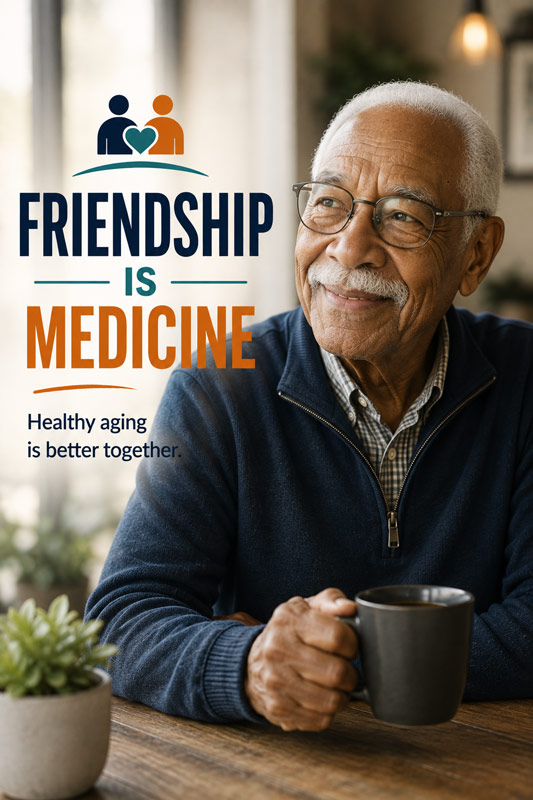
Friendship Is Medicine
Why Social Connection Is Essential for Healthy Aging
When we talk about healthy aging, we usually talk about what we should do.
Exercise.
Eat well.
Get enough sleep.
Keep our brains active.
But there’s another part of healthy aging that deserves just as much attention:
Other people.
Friendships, conversations, shared experiences, and the feeling that we belong somewhere aren’t simply enjoyable parts of life.
They’re part of living well.
And as we get older, maintaining those connections may require more intention than it once did.
Our Social Worlds Can Change as We Age
For much of our lives, connection happens naturally.
We go to work.
Raise children.
Attend school events.
See colleagues.
Meet neighbors.
Participate in organizations.
Then life changes.
Retirement happens.
Children move away.
Friends relocate.
A spouse or longtime friend may pass away.
Driving may become more difficult.
Suddenly, the social interactions that once happened automatically require effort.
An older adult can live independently at home and still spend much of the week alone.
That’s why successful aging in place has to mean more than simply remaining in your house.
It also means remaining connected to life outside of it.
Conversation Exercises the Brain
Think about everything your brain does during a good conversation.
You listen.
Remember.
Interpret.
Respond.
Laugh.
Tell stories.
Read facial expressions.
Consider another person’s perspective.
Social interaction engages the brain in ways that are difficult to reproduce through solitary activities.
A cup of coffee with a friend may look simple.
But there’s a lot happening around that table.
Friendship Encourages Healthy Habits
Friends don’t just make life more enjoyable.
They can also influence how we live.
A friend might encourage you to:
Take a walk.
Attend a class.
Try pickleball.
Go to lunch.
Volunteer.
Learn something new.
Get out of the house on a day when you might otherwise stay home.
Healthy behaviors often become easier when someone else is doing them with us.
We All Need Somewhere We Belong
There’s an important difference between being around people and feeling connected to people.
True connection means being known.
Someone notices when you arrive.
Someone remembers your name.
Someone asks how you’re doing.
Someone saves you a seat.
Someone notices when you’re missing.
That feeling of belonging matters at every age.
Making Friends After 60 Can Feel Different
One challenge we don’t discuss enough is how difficult it can be to make new friends later in life.
When we’re young, friendship often develops naturally through school, work, parenting, and other shared environments.
Later in life, we may have to create those opportunities intentionally.
The good news?
Friendship doesn’t have an age limit.
Classes, volunteer programs, walking groups, clubs, community organizations, faith communities, and shared-interest groups can all create opportunities for new relationships to grow.
The key is showing up consistently.
Friendships often begin with repeated small interactions.
A hello.
Then a conversation.
Then coffee.
Then someone starts saving you a seat.
Community Is Preventive Wellness
Healthcare usually enters the picture when something has already gone wrong.
But what if we invested more in the things that help people stay engaged before a crisis occurs?
Movement.
Nutrition.
Purpose.
Learning.
Sleep.
And connection.
That’s part of the idea behind the Longevity Day Club.
We’re creating a place where older adults can continue living in their own homes while having somewhere meaningful to go during the week.
A place to move.
Learn.
Laugh.
Eat.
Contribute.
Make friends.
And belong.
Because perhaps one of the most important questions we can ask about healthy aging isn’t simply:
“Where do you live?”
It’s:
“Who are you doing life with?”
Pilar’s Perspective
After more than two decades working with older adults, I’ve learned that loneliness doesn’t always look like loneliness.
Sometimes it looks like someone who hasn’t had a meaningful conversation in several days.
Sometimes it’s a person eating every meal alone.
Sometimes it’s someone who simply doesn’t have anywhere they need to be tomorrow.
That’s one reason I believe community needs to become a much bigger part of the healthy-aging conversation.
We need to think beyond healthcare.
People need people.
They need somewhere they belong.
They need someone who notices when they walk through the door.
And sometimes something as simple as friendship can give a person a completely different reason to look forward to tomorrow.
Did You Know?
Social connection is associated with better emotional well-being and healthier aging, while prolonged loneliness and social isolation have been associated with poorer health outcomes.
Connection isn’t simply social.
It’s part of wellness.
🌱 Longevity Day Club Challenge
Make One Connection
This week, intentionally connect with one person.
☎️ Call someone you haven’t spoken with recently.
☕ Invite someone to coffee.
🚶 Ask a friend to take a walk.
👋 Introduce yourself to someone new.
❤️ Check on someone who may be spending too much time alone.
One conversation may brighten two people’s day.
Why Hearing Is an Important Part of Healthy Aging
Hearing changes can happen so gradually that we may not notice them at first.
The television…
Why Balance Matters Long Before You Have a Fall
Most of us don’t think about balance until we lose it.
We walk across a parking lot, step off a…
 Call Now
 Schedule a Free Discovery Day