How Fast Do You Walk? What Walking Speed Can Tell You About Healthy Aging
How Fast Do You Walk?
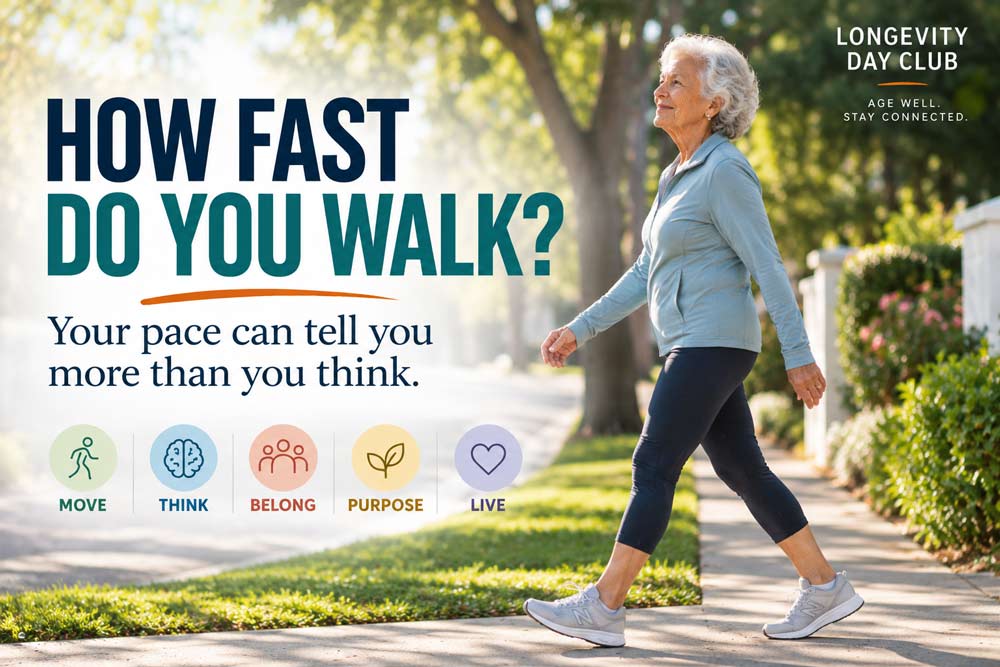
What Your Walking Speed Can Tell You About Healthy Aging
Most of us don’t think much about how fast we walk.
We simply get up and go.
But something as ordinary as walking across a room can provide useful information about how our bodies are functioning as we age.
That’s one reason gait speed—how quickly you walk a short distance—is commonly used as a measure of physical function in older adults.
And it’s one of the areas we look at when establishing a baseline at the Longevity Day Club.
Walking Requires More Than Your Legs
Walking may seem automatic, but your body is doing a lot of work.
Your muscles provide strength.
Your joints provide mobility.
Your brain coordinates movement.
Your balance helps keep you steady.
Your heart and lungs provide energy.
All of these systems have to work together to move you forward.
That’s why changes in walking speed can sometimes tell us something about changes in overall physical function.
It’s Not About Being Fast
This isn’t a race.
The goal isn’t to compare your walking speed with someone else’s.
What’s more useful is understanding your own starting point.
How are you moving today?
Then, after months of strength training, walking, balance work, and other healthy habits, we can ask:
Has anything changed?
That turns an everyday ability into something we can actually track.
Why Establish a Baseline?
We regularly measure things like weight, cholesterol, and blood pressure.
But if remaining independent is one of our goals, shouldn’t we also pay attention to our physical abilities?
Can you comfortably get out of a chair?
How is your balance?
How confidently do you walk?
Has your walking pace changed?
A baseline gives you a point of reference.
It isn’t about finding something wrong.
It’s about knowing where you are today.
What If You Want to Improve?
The good news is that physical function isn’t necessarily fixed.
Regular movement, strength training, balance exercises, and appropriate physical activity can all play a role in maintaining mobility as we age.
Start with small things.
Walk regularly.
Build lower-body strength.
Practice balance safely.
Avoid spending long stretches of the day sitting.
And if you’ve noticed a significant or unexplained change in the way you walk, talk with your healthcare provider.
Measure What Matters
At the Longevity Day Club, we believe healthy aging should be more intentional.
That’s why our approach begins with a personalized baseline and includes reassessment over time.
We don’t just want you to say:
“I think I’m doing better.”
We want to help you understand where you started and recognize where you’re making progress.
Because healthy aging isn’t about competing with someone else.
It’s about investing in your own future.
Pilar’s Perspective
We measure so many things as we age, but I’ve become increasingly interested in measuring the things that relate directly to how we live.
Walking is one of them.
Can I move confidently?
Can I continue going where I want to go?
Can I maintain the mobility that supports my independence?
That’s why gait speed is part of the baseline approach we’re developing at the Longevity Day Club.
It’s simple, but it gives us something valuable:
A number we can come back to.
For me, that’s what investing in how you age should look like.
Know where you are.
Work on the areas that matter.
Then measure again.
🌱 Longevity Challenge
Pay attention to how you move this week.
Don’t worry about a stopwatch.
Instead, notice:
Do I walk confidently?
Do I feel steady?
Do I get tired more quickly than I used to?
Do I avoid certain activities because of my mobility?
Then choose one thing you can do this week to support your strength, balance, or movement.
Your future independence starts with how you move today.

Why Hearing Is an Important Part of Healthy Aging
Hearing changes can happen so gradually that we may not notice them at first.
The television…

Why Balance Matters Long Before You Have a Fall
Most of us don’t think about balance until we lose it.
We walk across a parking lot, step off a…
 Call Now
 Schedule a Free Discovery Day