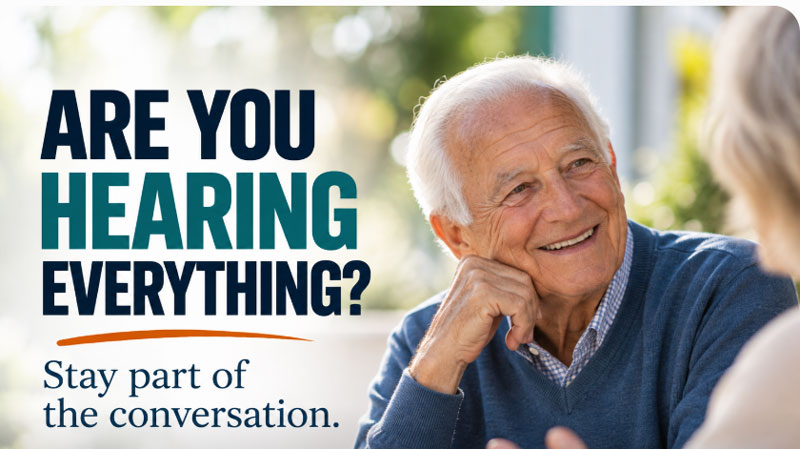
Are You Hearing Everything?
Why Hearing Is an Important Part of Healthy Aging
Hearing changes can happen so gradually that we may not notice them at first.
The television gets a little louder.
Restaurants become harder to follow.
You ask people to repeat themselves more often.
You start missing parts of conversations—especially when several people are talking at once.
It’s easy to dismiss these changes as a normal part of getting older.
But hearing isn’t simply about your ears.
It’s about staying connected to the world around you.
Hearing Keeps Us Connected
Think about how much of our daily life depends on hearing.
Conversations with friends.
A grandchild telling a story.
Music.
A lecture.
A phone call.
A joke across the dinner table.
When hearing becomes difficult, participating can require more effort.
Someone may begin avoiding noisy restaurants, group activities, meetings, or social events—not because they’ve lost interest, but because following the conversation has become frustrating or exhausting.
Over time, someone’s world can quietly become smaller.
Your Brain Is Part of the Conversation
Hearing isn’t passive.
Your ears receive sound, but your brain has to interpret it.
It distinguishes voices from background noise, recognizes words, follows conversations, and connects what you’re hearing with meaning and memory.
That’s one reason hearing deserves a place in the brain-health conversation.
Taking care of our hearing helps us continue participating in the conversations and experiences that keep our brains engaged.
Don’t Wait Until It’s Obvious
Just like walking speed and balance, hearing is something worth paying attention to before it becomes a major problem.
Ask yourself:
Do I frequently ask people to repeat themselves?
Is it difficult to follow conversations in restaurants?
Do people seem to mumble?
Have others told me the television is too loud?
Do I sometimes avoid situations because it’s difficult to hear?
If the answer is yes, it may be worth having your hearing professionally evaluated.
Knowing where you are today gives you information you can act on.
Technology Has Changed
For some people, the idea of addressing hearing changes immediately brings to mind bulky hearing aids from decades ago.
Technology has come a long way.
Today’s options can be smaller, more sophisticated, and easier to integrate into everyday life.
The goal isn’t simply to hear louder.
It’s to stay engaged.
Hearing Is Part of Independence
At the Longevity Day Club, we think healthy aging requires looking at the whole person.
How you move.
How you think.
How you connect.
How you experience the world around you.
That’s why sensory health—including hearing—belongs in the healthy-aging conversation.
Because living independently isn’t simply about being able to take care of yourself.
It’s about continuing to participate fully in your life.
Don’t let the world slowly become quieter around you.
Pay attention.
Get a baseline.
And keep listening to everything life still has to say.
Pilar’s Perspective
After more than two decades working with older adults, I’ve learned that some of the changes that affect quality of life happen very quietly.
Hearing is a perfect example. Someone may appear less social or less engaged when the real issue is that participating in a conversation has simply become harder.
That’s why I’m so interested in looking at healthy aging more broadly.
It’s not just blood pressure and lab results.
Can you move confidently?
Can you hear the people around you?
Can you participate in a conversation?
Can you stay connected to your community?
These are the things that help us continue living the lives we want.
Measure what matters.
🌱 Longevity Challenge
Listen to Your Life
This week, pay attention to your hearing.
At dinner.
On the phone.
Watching television.
In a restaurant.
Talking with friends.
Ask yourself:
Am I hearing comfortably—or am I working harder than I used to?
If you’ve noticed a change, consider making hearing part of your next health conversation.
Staying connected starts with being able to hear the people you care about.

Why Balance Matters Long Before You Have a Fall
Most of us don’t think about balance until we lose it.
We walk across a parking lot, step off a…

How Fast Do You Walk?
What Your Walking Speed Can Tell You About Healthy Aging
Most of us don’t think much about how fast we walk.
We simply…
 Call Now
 Schedule a Free Discovery Day