How Strong Is Your Grip?
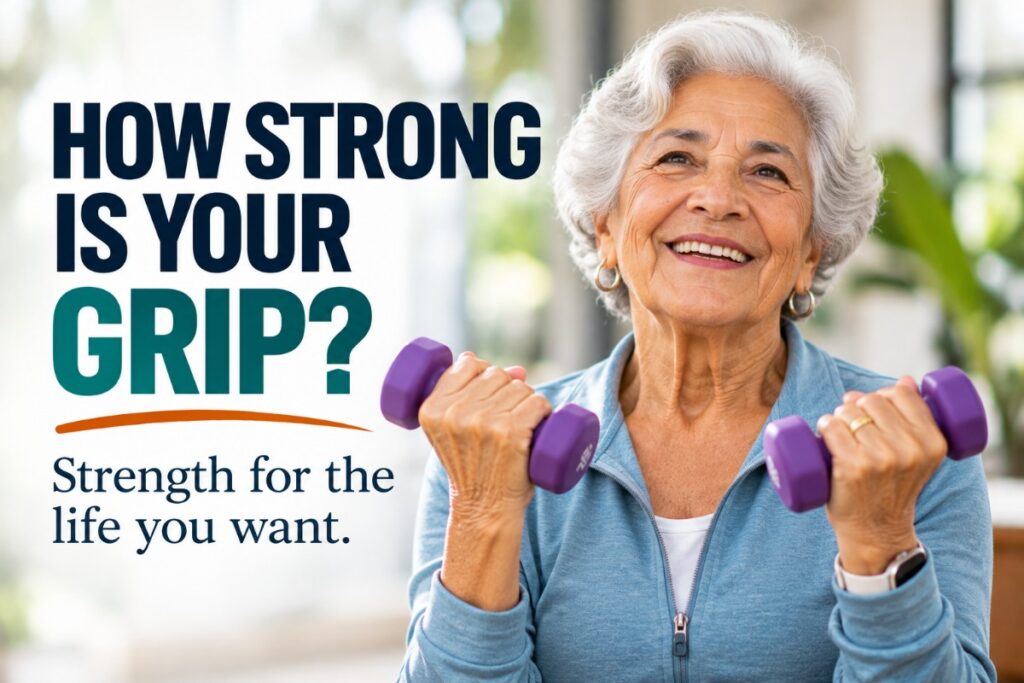 Why Hand Strength Can Tell Us Something About Healthy Aging
When was the last time you thought about how strong your hands are?
Probably not recently.
Yet we rely on our hands for countless activities every day.
Opening a jar. Carrying groceries. Gardening. Cooking. Holding a grandchild’s hand.
These simple activities require strength, coordination, and dexterity.
And as we age, maintaining that strength becomes increasingly important.
What may surprise you is that grip strength can tell us something about our overall physical health.
Your Hands Can Reveal More Than You Think
Grip strength is the amount of force you can generate when squeezing an object.
Researchers often use it as a simple measure of muscle strength and physical function in older adults.
Lower grip strength has been associated with greater risks of mobility limitations, disability, and other adverse health outcomes.
That doesn’t mean your grip strength alone determines how healthy you are.
But it can be one useful piece of the larger healthy-aging picture.
Strength Is About Independence
Think about the everyday activities that require strength.
Carrying groceries.
Opening containers.
Getting up from a chair.
Lifting a suitcase.
Playing with grandchildren.
Maintaining muscle strength helps us continue doing these things confidently.
And it’s not just about our hands.
Grip strength can serve as one indicator of broader muscular strength, which is essential to maintaining independence as we age.
Can You Improve Your Strength?
The encouraging news is that muscle strength can improve at almost any age.
Regular resistance training helps maintain and build muscle.
That might include:
- Lifting appropriate weights.
- Using resistance bands.
- Performing supervised strength exercises.
- Carrying manageable objects.
- Practicing functional movements.
For hand strength specifically, exercises involving gripping and squeezing may be helpful.
The key is choosing activities appropriate for your abilities and practicing consistently.
Know Your Starting Point
We’ve spent the past several weeks discussing the importance of understanding how our bodies function.
Hearing.
Vision.
Grip strength is another useful measure.
A healthcare or fitness professional can measure it using a handheld device called a dynamometer.
Having a baseline gives you a starting point.
Then, after participating in appropriate strength-building activities, you can reassess.
Are you maintaining your strength? Are you improving?
That’s the value of measuring what matters.
Strength for the Life You Want
At the Longevity Day Club, our MOVE pathway is about much more than exercise.
It’s about maintaining the physical abilities that allow us to continue living independently and participating in the activities we enjoy.
Because healthy aging isn’t about lifting the heaviest weight or competing with someone else.
It’s about staying strong enough to keep doing the things that make life meaningful.
Pilar’s Perspective
After more than two decades working with older adults, I’ve learned that strength matters in ways we often take for granted.
It’s not just about the gym.
It’s about being able to carry your own groceries.
Open a jar.
Lift a suitcase.
Get out of a chair.
And continue doing things independently.
I’ve become increasingly interested in simple measures that can help us better understand how we’re aging.
Grip strength is one of them.
At the Longevity Day Club, we want to encourage people to think about their physical abilities before they experience significant changes.
Know where you are today. Work on what matters. Measure again.
Because the goal isn’t simply to live longer.
It’s to remain capable and independent for as much of that life as possible.
🌱 Longevity Challenge
Put Your Strength to Work
This week, pay attention to the everyday activities that require strength.
Can you comfortably carry your groceries?
Open containers?
Lift and move everyday objects?
If you’re able, incorporate an appropriate strength-building activity into your week.
And remember:
Strength isn’t about how much you can lift. It’s about what your strength allows you to do.
Why Aging at Home Needs a Technology Platform
Connecting the Services, Resources, and Community That Make Independent Living Possible
Most older…

Why the Future of Aging Needs a More Connected Solution
Most older adults want to remain in their own homes as they age. They want to maintain…
 Call Now
 Schedule a Free Discovery Day