How Quickly Do You React?
Why Reaction Time Matters for Healthy Aging
Think about the last time you caught something before it fell.
Or stepped aside when someone unexpectedly crossed your path.
Or quickly adjusted your footing when you stumbled.
These everyday moments require something we rarely think about:
Reaction time.
It’s the time between noticing something and responding to it.
And as we age, our ability to respond to the world around us becomes an important part of maintaining confidence, mobility, and independence.
Your Brain and Body Work Together
Reaction time isn’t simply about moving quickly.
It’s about communication between your brain and body.
Your eyes and ears detect what’s happening around you.
Your brain processes that information.
Your nervous system sends signals to your muscles.
And your body responds.
All of this happens in moments.
As we get older, some of these processes may become slower. But that doesn’t mean we should stop challenging them.
Our brains and bodies benefit from continued engagement.
Why Reaction Time Matters
Reaction time plays a role in many everyday activities.
Catching your balance when you stumble.
Responding to changes while driving.
Moving around obstacles.
Participating in sports.
Dancing.
Even navigating a crowded grocery store.
When we think about maintaining independence, we often focus on strength and balance.
But being able to respond to unexpected situations matters too.
Can You Improve Your Reaction Time?
The encouraging news is that reaction time and coordination can be challenged through activities that combine thinking and movement.
Consider:
Dancing: Following rhythms and changing movements challenges coordination and attention.
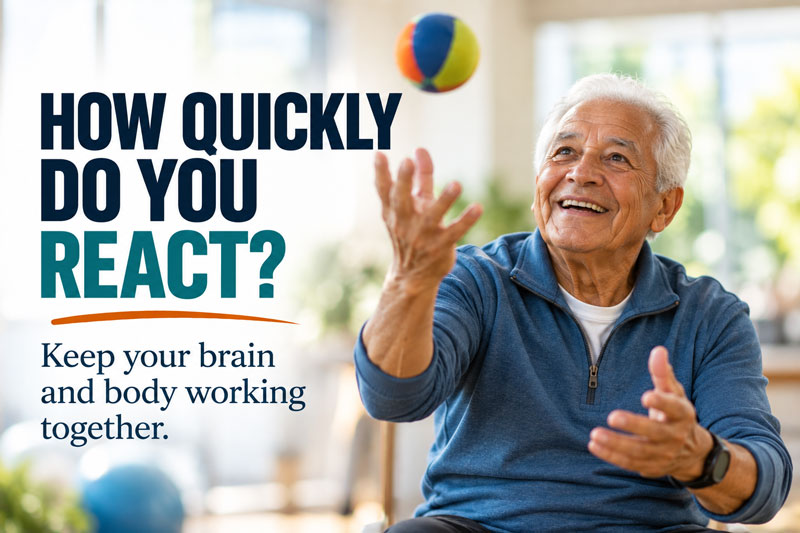
Ball games: Catching, tossing, or responding to a moving ball engages visual processing and movement.
Tai Chi: Controlled movements encourage body awareness, coordination, and balance.
Interactive games: Certain games challenge attention, decision-making, and response speed.
New activities: Learning unfamiliar movements encourages the brain and body to work together in different ways.
The goal isn’t to become faster than everyone else.
It’s to continue challenging the systems that help you respond confidently to everyday life.
Improvements in a particular exercise or game don’t necessarily translate into faster reactions in every real-world situation, but these activities can be enjoyable ways to stay physically and mentally engaged.
Don’t Forget the Bigger Picture
Reaction time doesn’t exist in isolation.
It works alongside many of the abilities we’ve explored in recent weeks.
- Walking speed.
- Balance.
- Hearing.
- Vision.
- Strength.
- Brain health.
Each contributes to how we navigate the world.
That’s why healthy aging requires looking at the whole person rather than focusing on one measurement.
Stay Ready for Life
At the Longevity Day Club, we believe healthy aging should be active, engaging, and intentional.
Through our MOVE and THINK pathways, we create opportunities for members to challenge both their physical and cognitive abilities.
Movement, coordination, learning, and interactive experiences are all part of building a lifestyle that supports healthy aging.
Because the goal isn’t simply to react faster.
It’s to stay confident, capable, and ready for whatever life brings.
Pilar’s Perspective
After more than two decades working with older adults, I’ve become increasingly interested in the connection between physical and cognitive health.
We tend to think about them separately.
Exercise for the body.
Brain games for the mind.
But everyday life requires both systems to work together.
When we stumble, our brain and body need to respond.
When we dance, we’re processing information and coordinating movement.
When we learn a new physical skill, we’re challenging both.
That’s why the Longevity Day Club brings movement and brain health together.
I want us thinking beyond individual activities and looking at how we maintain the abilities that allow us to continue living independently.
Healthy aging isn’t simply about staying active. It’s about staying capable.
🌱 Longevity Challenge
Challenge Your Brain and Body
This week, try an activity that requires both thinking and movement.
Dance to your favorite song.
Try a beginner Tai Chi class.
Play a gentle game of catch.
Learn a new sequence of movements.
Choose something enjoyable and appropriate for your abilities.
If you have balance difficulties, choose a seated or supported activity.
Keep moving. Keep thinking. Keep challenging yourself.

Why Aging at Home Needs a Technology Platform
Connecting the Services, Resources, and Community That Make Independent Living Possible
Most older…

Why the Future of Aging Needs a More Connected Solution
Most older adults want to remain in their own homes as they age. They want to maintain…
 Call Now
 Schedule a Free Discovery Day