Technology and Healthy Aging: Tools for Independence and Connection
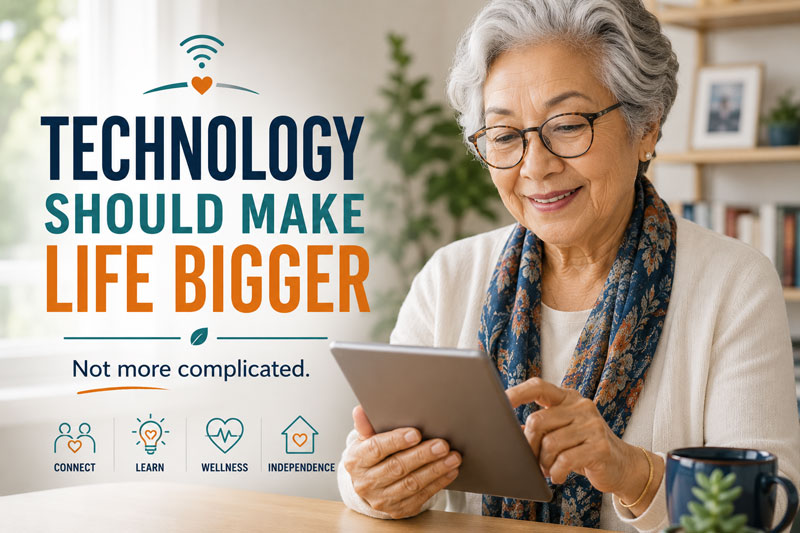
Technology Should Make Life Bigger
How the Right Tools Can Help Us Stay Independent, Connected, and Engaged
Technology has changed almost every part of our lives.
We use it to communicate.
Shop.
Travel.
Learn.
Exercise.
Manage our health.
Find directions.
Listen to music.
See our grandchildren.
And increasingly, technology is becoming part of how we age.
But when we talk about technology and older adults, I think we sometimes ask the wrong question.
We ask:
“Can they use it?”
Perhaps we should be asking:
“Can it make their life better?”
Because technology isn’t the goal.
Living well is the goal.
Technology Can Help Us Stay Connected
For families living across cities, states, or even countries, technology can make distance feel smaller.
Video calls allow grandparents to see grandchildren.
Group chats keep families connected.
Online communities introduce us to people who share our interests.
A phone or tablet can’t replace sitting across the table from someone we love.
But it can help us stay connected when being together isn’t possible.
Technology Can Support Independence
Some of the most exciting technology isn’t flashy.
It simply makes everyday life easier.
Transportation apps can help someone get to an appointment.
Medication reminders can help organize daily routines.
Smart-home technology can simplify lighting and temperature controls.
Wearable devices can track movement and other wellness information.
Telehealth can make certain healthcare services easier to access.
The best technology often works quietly in the background, removing barriers to independence.
Technology Can Keep Us Learning
In Issue 9, we talked about lifelong learning.
Technology has opened an extraordinary doorway to it.
Today, you can learn almost anything from almost anywhere.
Take a university course.
Tour a museum.
Learn a language.
Attend a lecture.
Research your family history.
Listen to a podcast.
Learn to paint.
Explore a destination before you travel.
Curiosity no longer has to be limited by geography.
Technology Can Help Us Understand Our Health
One of the biggest opportunities in healthy aging is helping people better understand what’s happening in their own bodies.
Technology can help us track things like:
Movement.
Sleep.
Heart rate.
Exercise.
Nutrition.
Cognitive performance.
But data alone isn’t enough.
The real value comes when information helps us make better decisions.
Technology should give people greater ownership of their health—not overwhelm them with numbers.
Confidence Matters
Many older adults are perfectly comfortable with technology.
Others aren’t.
And that’s okay.
No one should feel embarrassed because they don’t know how to use a new device or app.
Technology changes quickly for all of us.
Learning it should feel empowering, not intimidating.
Sometimes all it takes is someone sitting beside you and saying:
“Let me show you.”
Technology Should Never Replace People
This may be the most important point.
Technology can support connection.
It cannot replace belonging.
An app cannot replace a friend.
A wearable cannot replace encouragement.
A video call cannot completely replace a hug.
Technology works best when it strengthens human relationships rather than substitutes for them.
The Future of Aging Is High-Tech and High-Touch
At the Longevity Day Club, we’re interested in technology because of what it can help people do.
Stay healthier.
Understand themselves better.
Get where they need to go.
Connect with family.
Learn.
Explore.
Access resources.
Remain independent.
But technology will always be only one part of the equation.
The other part is human.
Friendship.
Purpose.
Movement.
Learning.
Laughter.
Community.
The future of healthy aging isn’t technology versus people.
It’s using technology to help people live bigger lives.
Pilar’s Perspective
I’ve spent much of my career thinking about how we help middle-income older adults remain independent longer.
Technology has to be part of that conversation.
But I’m not interested in technology simply because it’s innovative.
I’m interested in whether it solves a real problem.
Does it make healthcare easier to access?
Does it help someone get transportation?
Does it identify a change in health earlier?
Does it help someone connect with family?
Does it make aging at home easier?
Does it give someone more control over their life?
If the answer is yes, then I’m interested.
Technology should never make aging feel more complicated.
It should make living easier.
Did You Know?
Technology can support many parts of healthy aging—from transportation and communication to learning, wellness monitoring and access to healthcare.
But the best technology begins with a simple question:
What problem are we trying to solve?
🌱 Longevity Day Club Challenge
Learn One New Technology Skill
This week, try one thing you’ve been avoiding.
📱 Make a video call.
🎧 Listen to a podcast.
🗺️ Learn to use a navigation app.
⌚ Explore one feature on a smartwatch.
📚 Take an online class.
🎵 Create a music playlist.
🤖 Try an AI tool.
Ask someone to help if you need it.
Being a beginner is part of learning.

Why Healthy Aging Should Start Before Something Goes Wrong
We plan for retirement.
We plan where we want to live.
We plan vacations.
We…

Why Lifelong Learning Matters for Healthy Aging
When was the last time you did something for the very first time?
Learned a new skill.
Tried a…
 Call Now
 Schedule a Free Discovery Day